Solar Energy UK
23 June 2026
As all eyes are on the World Cup, sporting venues big and small across the country are increasingly turning to solar power to cut their energy bills.
Solar Energy UK member EvoEnergy recently installed more than 3,000 panels at the Principality Stadium in Cardiff – thought to be the largest of its kind in Britain.[1,2] Ascot Racecourse also announced the completion of a 1,200-panel, 600-kilowatt array earlier this month.[3]
The Principality Stadium project is expected to pay for itself within only three years and seven months, highlighting the financial sense of installing solar energy.
The completed 1.5-megawatt system comprises 3,296 Trina 455-watt modules and will generate approximately 1,241,800 kilowatt-hours of renewable electricity each year. It will supply 22% of the stadium’s electricity demand while avoiding having to draw 1.2m kWh of power from the grid.
The project should also save about 260 tonnes of CO2 emissions annually, contributing meaningfully to the Welsh Rugby Union’s climate ambitions.
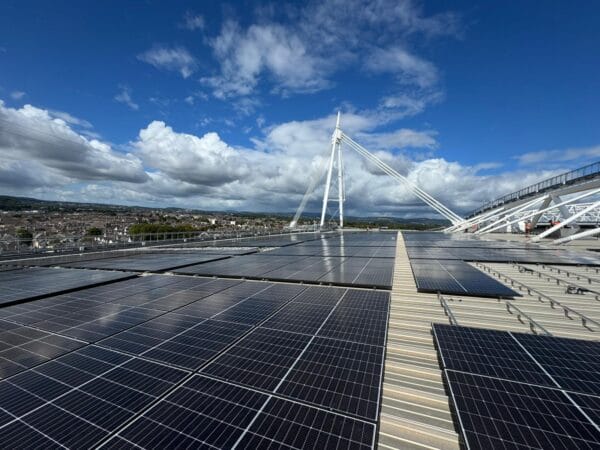
The work followed the replacement of four substations and other electrical works by CX Energy, part of fellow SEUK member RSK Group.
Logistics were particularly complex due to the stadium’s riverside location, which prevented the use of conventional external lifting methods. All materials had to enter via the “Dragon’s Mouth” pitch entrance. A large crane was positioned at the centre of the pitch to lift pallets and equipment approximately 60 metres to roof level.
Although the overall installation programme spanned six weeks, the crane was available for only two weeks, meaning that every mounting system, panel and associated component had to be lifted onto the roof before the playing surface was reinstated.
“We are proud to have partnered with the Welsh Rugby Union to deliver the largest rooftop solar installation on a UK stadium. This landmark project is a proof to the ambition and collaboration of everyone involved, supporting the WRU’s sustainability goals and demonstrating how iconic sporting venues can lead the transition to clean energy,” said Diala Isid, Senior Renewable Energy Consultant at EvoEnergy.
Ascot
Running for almost 300m along the Grandstand, the 608kW Ascot project should generate around 570,000kWh of energy each year: enough to drive a medium-sized electric car over a million laps of the course, saving 118 tonnes of CO2 per year. All power is expected to be used on site, covering around 9% of the site’s electricity consumption, once its grid connection is completed later this summer.
The rooftop system, installed by SSE Energy Solutions and Ortus Energy, will help Ascot with its ambition to be one of the most sustainable sporting venues in the world. As well as Royal Ascot and other racedays, it will support day-to-day operations and more than 180 non-racing events held at the venue each year.
Installed across the 480‑metre-long roof of the Grandstand, the array has a total capacity of 608kW and comprises more than 1,200 solar panels. It is expected to generate approximately 569,000kWh of renewable electricity in its first year once energised, enough power for a medium sized electric car to drive just over one million laps of the course.
A horse running at 40mph would need to run non-stop for 14 and a half years to produce the same amount of energy, according to Ascot.
Felicity Barnard, Chief Executive of Ascot Racecourse, said: “This installation is a significant milestone for Ascot. It allows us to take a major step forward in our plans to cut emissions and strengthen the resilience of our operations. By turning our Grandstand roof into a long-term energy asset, and bringing the system online later this year, we will be supporting both our environmental commitments and the future sustainability of the racecourse.”
Tennis
The prestigious Queen’s Club in West London has a 915-panel, 421kW solar system built on several of its buildings, outputting 360,000 kilowatt-hours of electricity and saving around 55 tonnes of CO2 per year. Another EvoEnergy project, it cut the club’s reliance on grid electricity by a quarter, with an estimated payback of three years.
Football
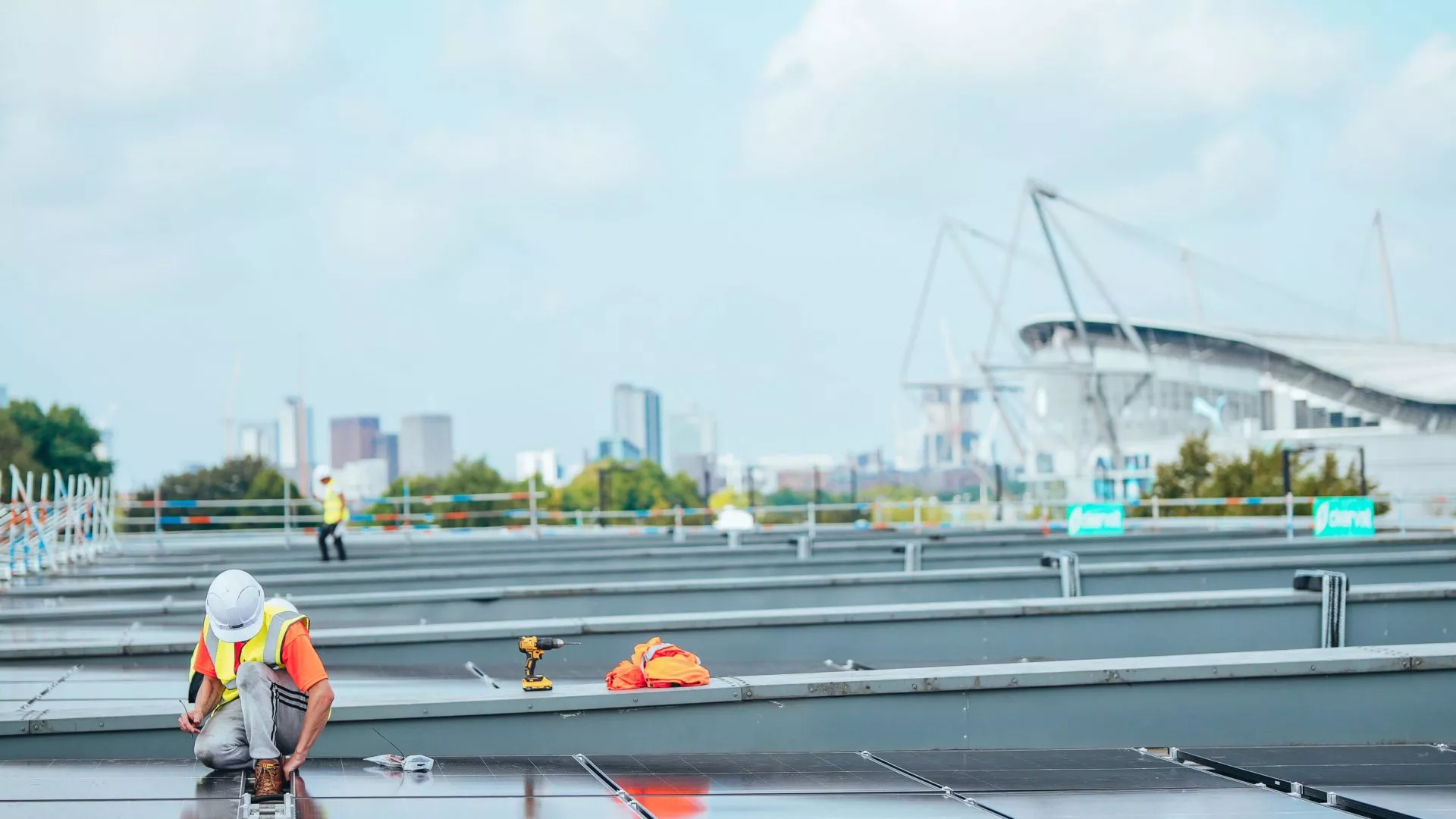
Manchester City is a world leader in solar energy generation among football teams, installing 2,800 panels – enough to cover its annual power requirements – on its training grounds and the Joie Stadium, home of its development squad and women’s team. The system feeds excess power to the main Etihad Stadium.[4]
The panels were supplied by JinkoSolar and are managed by AMPYR Distributed Energy, both SEUK members.
Last year, the London Stadium (formerly the Olympic Stadium, home to West Ham) had 6,500-square metres of lightweight solar membrane fitted to its roof by SEUK member Ameresco.[5] Part of a wider £4.35m project of energy upgrades intended to cut energy drawn from the grid by a third, it was funded via a loan from the Mayor of London’s Green Finance Fund, plus some initial grant support. Expected to generate 850,000kWh each year, it is big enough to power all power all the venue’s major events.
Community sport
A great many amateur, non-league and community football, rugby and cricket clubhouses and stadiums have been fitted with solar energy.
The England and Wales Cricket Board helped fund Redruth Cricket Club to fit 20 ground-mounted panels alongside a battery energy storage system, cutting electricity bills by 40% – about £3,000 per year.[6] Similarly, Minster Cricket Club in Kent is saving £1,400, according to Kent Cricket.[7]
Newquay AFC boasts 27 solar panels and 37.5kW of battery energy storage at its Mount Wise Stadium.[8]
Last year, Fullerians Rugby Club in Watford installed a 51kW solar system with 9kWh of battery storage, enough to power the equivalent of 15 homes each year and save 12t of CO2 annually. At the time, payback was expected within only three years and three months.[8]
Each year, the system will eliminate 12 tonnes of carbon dioxide emissions – equivalent to planting approximately 550 trees annually, removing nine petrol vehicles from the road or offsetting the emissions from nearly 30,000 miles of air travel.
[1] Largest solar panel installation at a UK sports venue fitted to the roof of Principality Stadium – Principality Stadium
[2] Principality Stadium case study – EvoEnergy
[3] Ascot Racecourse completes one of UK sport’s largest solar installations to support sustainability ambitions – Ascot Racecourse
[4] More than 2,800 solar panels installed on the Joie Stadium’s roof – Manchester City FC
[5] Revolutionizing Iconic Event Venue’s Sustainability with Innovative and Flexible Solar PV Solution – Ameresco
[6] ECB Boosts Cricket Clubs with Solar Panel Grants to Tackle Energy Costs and Carbon Footprint – Commercial Solar Group
[7] Powering the Game: How Cricket Clubs Are Going Solar – Kent Cricket
[8] Newquay AFC Powers Up with Solar Energy Installation at Mount Wise Stadium – Newquay Voice
[9] Fullerians Rugby Club powers up with solar panels thanks to council’s Neighbourhood Grant – Watford Borough Council
– ENDS –
Editor’s notes:
For more information or to request an interview, please contact:
Gareth Simkins, Senior Communications Adviser
news@solarenergyuk.org | solarenergyuk.org
About Solar Energy UK: Solar Energy UK is the largest trade association representing the solar and battery storage sector. It represents over 400 member organisations. Its membership includes companies working across both rooftop and ground-mounted solar – delivering projects that contribute to a clean, secure energy system and help reduce energy bills for homes and businesses.
Author

Gareth Simkins
Senior Communications Adviser
Talk to me about
PR Crisis Management • PR & Media • NSIP Communications