Solar Energy Scotland
13 January 2026
The Scottish Government faces fresh criticism for axing support for solar power in Scotland, after a new academic study revealed that its solar loan scheme, abandoned in 2023, helped to reduce fuel poverty. Industry figures show the number of installations plummeting since the removal of the interest-free loan scheme.
Scotland’s solar trade body has published a manifesto for solar in the forthcoming election calling for the loan scheme to be re-instated, among a range of other measures including a 2035 installation target.
Home Energy Scotland loans delivered relatively greater increases in adoption in poorer areas than richer places, resulting in installation inequality declining in Scotland while it increased in England, according to a Grantham Research Institute paper.[1] After loans were withdrawn abruptly after six years, a move condemned by trade group Solar Energy Scotland.[2]
“The loss of interest-free loans for solar power from Home Energy Scotland was a big mistake. The report lays that out in black and white,“ said Solar Energy Scotland chair Josh King. When still available, Scotland accounted for more than a quarter of all the UK’s smaller-scale rooftop installations. That proportion has since fallen to barely a tenth.
“The gains were high impact, low cost, distributed broadly across social groups and around the nation, too. In the absence of them, combined with ill-considered changes to building standards, Scotland has gone from having more than a quarter of the UK’s smaller-scale rooftop solar market to barely a tenth over six years. That has had consequential implications for energy poverty, the economy and our nation’s energy security,” he added.
Moreover, “The idea that solar works far better in England than Scotland is a myth. Only ten percent less would be generated in Edinburgh than in London – and actually more than in Manchester, for example,” King said.
As the paper states, in 2017 the Scottish Government introduced the loan scheme to boost household energy efficiency. They were available to all homeowners and private landlords, unrestricted by income. During 2017–2021, the paper’s sample period, solar photovoltaic systems were eligible as a stand-alone measure. The cap for them rose from £2,500 to £5,000 in May 2018.
The scheme arrived at a crucial time, as support under the old feed-in tariff mechanism steadily declined. It fell from an initial 41.3p per kilowatt hour generated in 2010 to 3.79p/kWh when it closed for new applications in April 2019. Similar loans were unavailable in England.
The paper says that the loans added around 21,000 additional solar PV installations. That equates to around 33 gigawatt hours per year, or 0.4% of Scotland’s total domestic electricity consumption. To put it another way, they would generate enough power to power all the homes in Dumfries for a year.
“Distributionally, gains were broad and not concentrated among high-wealth or rural areas, delivering more equitable benefits than alternative PV subsidies,” the academics wrote.
King continued: “More broadly, we are very concerned that the Scottish Government appears to have lost interest in the manifold potential of solar energy – whether on the ground, on new homes or retrofitted to existing buildings.[4] After three years in draft, the Solar Vision appears to have been airbrushed out of existence as it is not mentioned at all in the draft Climate Change Plan.[5,6] The contrast with Whitehall’s enthusiastic backing could not be clearer.
“We are also worried about the trajectory of heat pump installations, which pair excellently with home solar and battery storage systems. In 2020, one in five of the UK’s new heat pumps were put in Scottish homes and buildings. Last year, it was barely 11%.
“Solar offers a huge opportunity to cut bills by being able to generate cheap energy and use it at source in homes and businesses. Ahead of the elections, we have sent our own solar manifesto to all parties which, if adopted, would see the next Scottish Government reinstate the loan scheme, a Solar Vision brought back to life and a target for nine gigawatts of solar generation capacity in Scotland by 2035 as a fair share of the UK target of almost 60GW by then. We also propose mandating solar power in new buildings, restoring loans and cutting grid operators’ red tape, too,” King said.
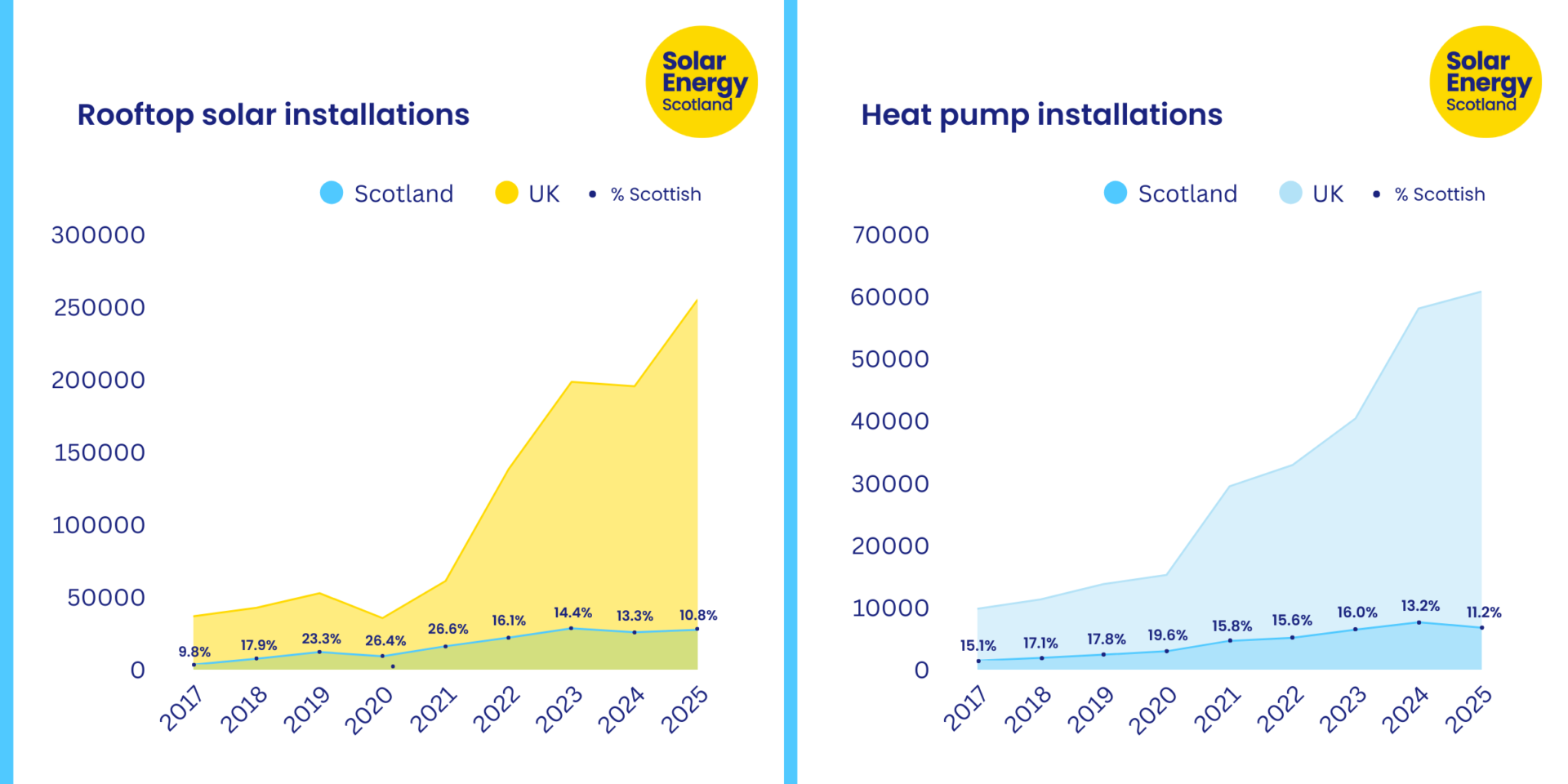
Rooftop solar installations
| Year | UK | Scotland | % Scottish |
| 2017 | 36983 | 3633 | 9.8% |
| 2018 | 42784 | 7660 | 17.9% |
| 2019 | 52808 | 12291 | 23.3% |
| 2020 | 35694 | 9431 | 26.4% |
| 2021 | 61237 | 16309 | 26.6% |
| 2022 | 138262 | 22263 | 16.1% |
| 2023 | 198437 | 28589 | 14.4% |
| 2024 | 195410 | 25929 | 13.3% |
| 2025 | 255082 | 27636 | 10.8% |
Data: MCS. Refers to solar photovoltaic installations with a capacity of 50 kilowatts or less.
Heat pump installations
| Year | UK | Scotland | % Scottish |
| 2017 | 9839 | 1487 | 15.1% |
| 2018 | 11334 | 1934 | 17.1% |
| 2019 | 13787 | 2448 | 17.8% |
| 2020 | 15273 | 2993 | 19.6% |
| 2021 | 29508 | 4670 | 15.8% |
| 2022 | 32931 | 5149 | 15.6% |
| 2023 | 40429 | 6475 | 16.0% |
| 2024 | 58078 | 7659 | 13.2% |
| 2025 | 60812 | 6789 | 11.2% |
Data: MCS. Refers to all forms of heat pumps of 45 kilowatts of thermal output or less, or systems of up to 70kWth if using more than one heat pump.
[1] Adoption, incidence and welfare impacts of interest-free loans: evidence from solar PV – Grantham Institute
[2] ‘No warning’ of withdrawal of Scotland’s solar home loans – Solar Energy Scotland
[3] Axed solar loans helped poorer households more than rich – The Herald
[4] Holyrood leaving solar energy in the shade – Solar Energy Scotland
[5] Scottish Solar industry welcomes commitment to boost solar energy generation in Scotland – Solar Energy Scotland
[6] Scotland’s Climate Change Plan – 2026-2040 – Scottish Government
– ENDS –
Editor’s notes
For more information or to request an interview, please contact:
Gareth Simkins, Senior Communications Adviser
Author

Gareth Simkins
Senior Communications Adviser
Talk to me about
PR and Media