10 March 2026
The solar industry has long maintained that solar farms occupy a minimal proportion of the nation’s most productive farmland. Recent data now provides empirical support for this assertion.
Government planning data indicate that solar farms occupy approximately 0.1% of the UK’s land area, a proportion insufficient to have any material impact on national food production.
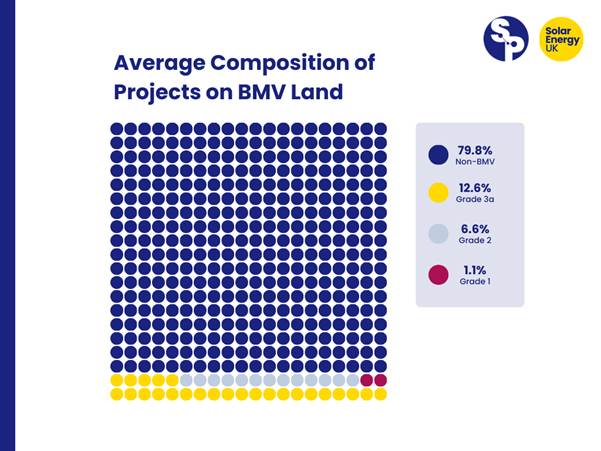
Data from Solar Energy UK’s SolarPulse platform, which tracks all solar installations over five megawatts across the development and operational lifecycle, show that only 37.6% of solar farms include any areas identified as ‘best and most versatile’ (BMV) agricultural land. Of this minority, only an average of 20% of each site is located on BMV land.
Understanding BMV Land
In England, land is graded from 1-5, based on suitability for agricultural production, incorporating factors such as climate, flood risk, soil depth, and more.
Additional classifications include other non-agricultural uses, such as golf courses, landfill sites, quarries, and urban areas.
The BMV designation includes grades 1, 2 and subgrade 3a, with all grades summarised as follows:
- Grade 1: Suitable for salad crops, winter vegetables, fruit growing and a wide range of other crops.
- Grade 2: Similar to grade 1, but with lower productivity and crop range.
- Grade 3: Land with moderate limitations that affect the choice of crops, timing and type of cultivation, harvesting or the level of yield. Where more demanding crops are grown, yields are generally lower or more variable than on superior land. Grade 3 is split into two subgrades:
- Subgrade 3a: Suitable for mixed farming, less demanding horticultural crops, high-yield grazing and the cultivation of cereals.
- Subgrade 3b: Predominantly grass and cereals.
- Grade 4: Predominantly grass, with some oats, barley or forage crops.
- Grade 5: Largely mountain and moorland, with some rough grazing, being largely unsuitable for arable use.
Why use good farmland at all?
Planning policy directs ground mounted solar farms to areas of previously developed or lower grade agricultural land, where such opportunities exist, to avoid unnecessary loss of BMV land but development is not prohibited.
National Policy Statement EN-3 states that land type should not be a predominate factor in determining the suitability of a site for solar development. This is particularly relevant as areas of poorer quality land are often constrained for other reasons such as the absence of suitable grid access, flood risk, terrain difficulties or the land simply being unavailable for development.
These factors combine to result in some solar farms being constructed on agricultural land, predominantly grade 3b, which is outside BMV protections yet practical for development.
Solar farms are unique in that they do not permanently restrict land access. Agricultural activities such as grazing can often continue alongside solar installations. In addition, planning conditions typically require that solar structures are temporary and dismantled after the end of the operational period.
Solar Farms can support multifunctional land use
Solar has the potential to play an increasingly important role in the rural economy.
According to the Energy & Climate Intelligence Unit, arable farms suffered losses exceeding £800m last year, following one of the worst harvests on record. With rising input costs for fertiliser and other essentials, farmers are facing increasing financial pressure amidst unpredictable climate changes. Case studies and public statements by the National Farmer’s Union (NFU) indicate that British farmers are among the biggest supporters of solar energy.
By providing reliable and predictable income streams, solar farms can help underpin core farming activities by enabling reinvestment in equipment and land management amid economic pressures and provide added benefits to biodiversity and soil health, while generating renewable electricity.
Well-designed solar farms can support multifunctional land use, delivering measurable environmental co-benefits alongside continuing some agricultural practices and delivering clean power generation. Management practices associated with solar farms can benefit both agricultural yield and biodiversity. By moving to methods such as low-intensity or rotational grazing, reduced use of agrochemicals, and the creation of wildflower-rich grassland within solar farms, farmers can create diverse habitats that support pollinators, birds, and small mammals, while also reducing soil disturbance and improving soil health compared to conventional arable use.
In many cases, solar farms allow land to rest from intensive cultivation. Periods of fallowing, combined with improved ground cover and active land management plans allow long-term improvements in soil health over the operational lifespan of a solar farm. Over time, these changes can contribute to improved soil health and long-term agricultural resilience, demonstrating that solar deployment and land stewardship can be mutually reinforcing objectives.
Overall, the data demonstrates that solar farms occupy only a very small proportion of BMV land. Where they do intersect with it, the areas involved are typically limited and carefully assessed through the planning process. In return, these projects deliver multiple complementary benefits: restoring and enhancing habitats, supporting pollinators and wider biodiversity, improving soil condition through reduced intensity management, and generating secure, low-carbon electricity. At the same time, they provide farmers with stable, diversified income that strengthen business resilience. Properly planned and managed, solar projects represent a land use that aligns environmental restoration, clean energy delivery and long-term financial resilience for the agricultural economy rather than setting them in opposition.
SolarPulse

SolarPulse is the UK’s leading market intelligence platform for solar and battery projects, providing data on over 5,000 utility-scale solar and battery projects across the UK with full lifecycle tracking, interactive mapping and custom data insights.
Find out more about SolarPulse HERE
⚡Engage with projects at the earliest opportunity, highlighting opportunities to tender for business.
🔌Stay ahead of competitors with frequent updates, advanced search capabilities and interactive mapping.
☀️ Track and analyse projects using our powerful filtering tools – project name, capacity, development status, location and ownership, plus details on biodiversity net gain and land quality.
🔋 Download data for analysis.
Email Stephanie Wong on solarpulse@solarenergyuk.org for more information.
Author

Gareth Simkins
Senior Communications Adviser
Talk to me about
PR Crisis Management • PR & Media • NSIP Communications